
Behind the scenes with our stand designers.
New trends in the stand world, news from WENES Stand, practical advice for your project, not-to-be-missed dates and exciting partnerships.
Here, we share everything that's important to us!

17 candles and not a wrinkle!
At WENES Stand, the month of October is synonymous with a customized stand marathon!

A seminar in the sun with the WENES team
Let's take a look back at this nuggety moment and share our recipe for a more-than-perfect seminar.
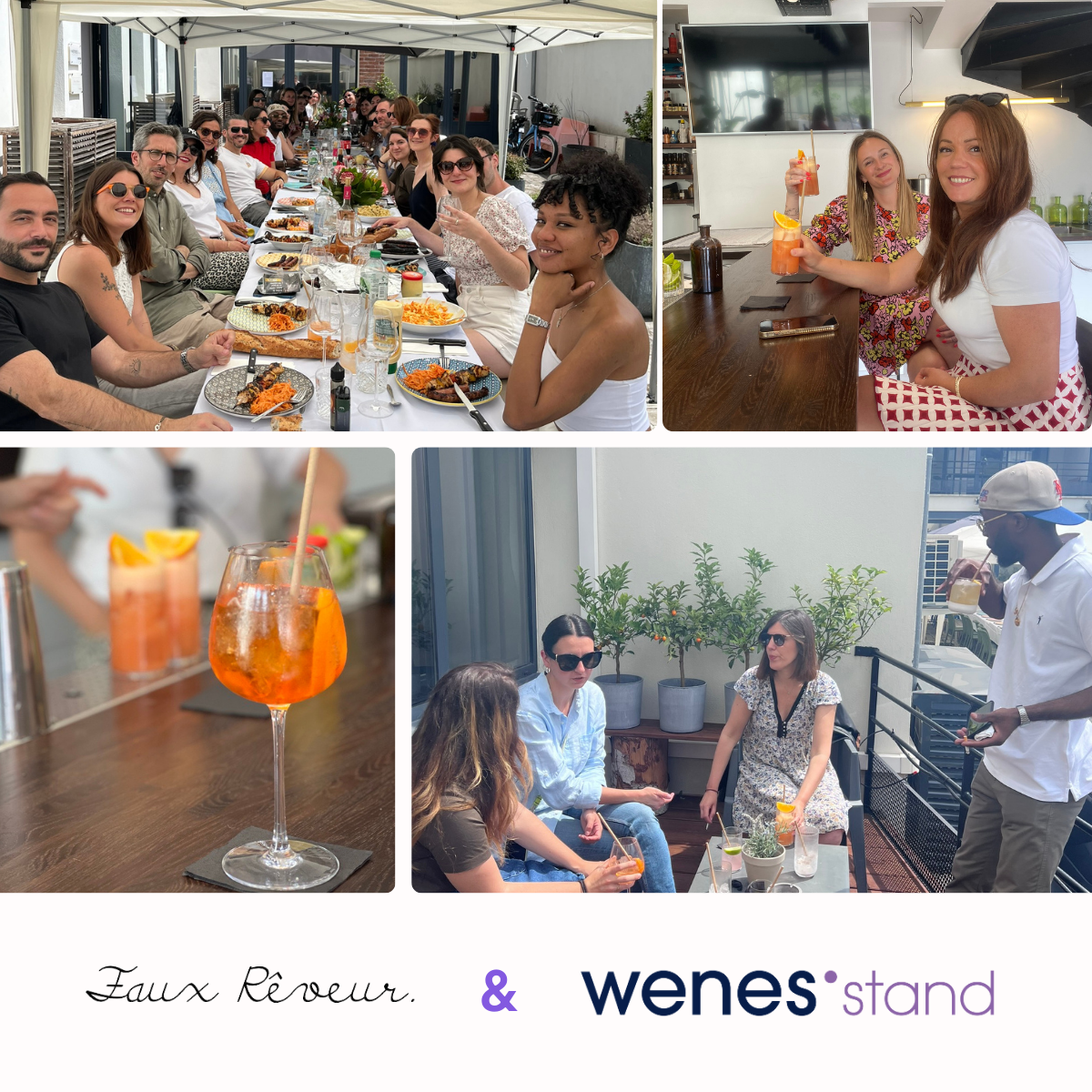
Agence Faux Rêveur & WENES
On Friday, we put aside our computers and meetings to enjoy a barbecue...


Guess who is your Valentin(e) ?
Today is the festival of love, so we thought we'd bring you a little more...
Agence Faux Rêveur & WENES
On Friday, we put aside our computers and meetings to enjoy a barbecue...
WENES CUSTOM
A project for customized stand?
We are here to hear you.
F.A.Qour booth operators answer your questions
How to set up an exhibition stand?
A well-designed stand is based on a clear organization of the space into functional zones: reception, demonstration, exchange and storage. Each zone must serve a precise purpose and fit naturally into the visitor's itinerary.
Design starts with flow: how visitors enter, move around, stop and engage. An open, visible reception area encourages initial contact. A well-positioned demonstration area attracts attention. A more intimate meeting cubicle allows for more in-depth, qualified exchanges. A discreet but accessible storeroom ensures team comfort throughout the show. Lighting, furniture and signage then reinforce each zone without overloading the whole. A good layout can't be seen, it can be felt in the fluidity of the experience.
How to attract visitors to your stand?
Attracting visitors to a stand relies on three inseparable levers: visual legibility from the aisles, coherence between the brand identity and the space, and the human energy exuded by the teams present.
An attractive stand doesn't try to show everything at once. It prioritizes, guides the eye and creates a natural entrance. Location plays an important role; a strategic axis of passage changes everything, but it's not enough. Lighting, signage, animation zones and the posture of the teams contribute as much to attractiveness as the architecture itself. The stands that perform best are those that tell a coherent story from the very first seconds, and make people want to enter effortlessly.
Our 2026 trends detail the design and digital levers that are performing this year.
How to choose a stand builder?
Choosing a stand builder means choosing a trusted partner for a project that involves your brand image. The essential criteria: experience in the field, a comprehensive portfolio, the ability to manage the entire project, from design to dismantling, and the ability to listen from the outset.
Beyond technical skills, human relations are just as important as know-how. A good stand designer must be able to understand your marketing challenges, challenge your ideas and provide you with solutions you hadn't considered before. Check out their presence at the trade shows you frequent, their references in your sector, and their ability to work wherever you exhibit, in France and abroad. Feelings count. So does trust. That's what turns a one-off collaboration into a lasting partnership.
To go further, consult our guide: 7 criteria for choosing a good exhibition stand builder.
How to choose a stand location at a trade show?
Your choice of stand location is highly strategic. To be successful, you need to consider a number of factors, such as :
- proximity to competitors and catering areas,
- the main visitor flows through the show aisles, to make sure you're on a strategic axis with respect to your target,
- your location in relation to the show layout,
- As a bonus, keep an eye on the technical plans for the show: it would be a shame to be positioned on a site with several poles that are impossible to move. Luckily, WENES Stand can deal with all your problems, and transform them to your advantage.
What's the difference between a custom-built stand and a modular stand?
A custom-built stand is designed specifically for a company, a trade show and a precise objective, with total architectural freedom. A modular stand is based on standardized components that can be reconfigured from one event to the next, with optimized lead times and logistics.
Both approaches have their relevance. Tailor-made solutions are essential when image is at stake, when the surface area is large or when the concept requires a specific scenography. Modular solutions are better suited to a multi-show strategy, tight schedule constraints or systematic reuse. Some projects combine the two: a modular base enriched with customized elements to create a hybrid stand that's both flexible and impactful. The right choice always depends on objectives, context and frequency of participation.
Are you hesitating between the two? Our Decision support matrix guides you based on your specific situation.