
How do you create a custom stand? From idea to D-day
03/03/2026
Creating a custom stand never starts with a plan. It starts with an intention.
Behind every project lies a strategic question: what should happen on this stand?
A product launch?
An institutional statement?
A special moment with key customers?

The creation of a customized stand follows a structured process - listening, design, 3D modeling, manufacturing, coordination and installation - but this process is never mechanical.
It serves an ambition.
The structured method to achieve this ambition:
- Analysis of objectives
- Architectural design
- 3D modeling
- Technical studies
- Manufacturing
- Logistics coordination
- Assembly
- Post-show follow-up
It all starts with listening and briefing
Before talking about volumes or materials, we need to understand the context.
Why this show?
Why now?
Why this surface?
A made-to-measure stand is not an automatic response to a given number of square meters. It's a spatial translation of a strategy.
This phase of reflection is essential for laying the right foundations - we discuss it in greater detail in our article on briefing:
👉 How to brief your stand designer for the ideal stand.
A successful stand is never spectacular by chance. It's relevant because it's aligned.
From intention to concept: shaping strategy
Once the objectives have been clarified, the design phase begins.
The stand designer's role goes far beyond manufacturing. He analyzes, prioritizes, structures and translates strategy into architecture.
1. Remote reading
In an exhibition hall, the first battle is fought over several meters. Height, volume, signage and architectural lines determine a stand's ability to stand out in its environment.
A custom-built stand allows you to work on this strategic visibility: vertical play, suspensions, cut-outs, contrasting materials.
2. Traffic flow and accessibility
Once attracted, visitors must be able to enter naturally. The opening of a corner, the positioning of a reception desk, the width of a passageway: these elements have a direct influence on visitor behavior.
A stand that's too closed intimidates. A stand that's too open dilutes the message. The right balance is struck at the design stage.
3. Prioritizing information
At a trade show, attention spans are short. An effective stand doesn't show everything at once.
It guides the eye.
-
An immediately identifiable main message
-
A secondary offering visible from a short distance
-
More confidential spaces for in-depth analysis
The stand then becomes a trail.
4. The overall experience
Finally, the design incorporates a more subtle dimension: atmosphere.
Light can create heat or tension. Materials can express robustness, innovation or environmental commitment. Furniture can invite discussion or encourage demonstration.
A custom-built stand offers total architectural freedom. Every element - height, material, light, rhythm - can be adapted to the brand's identity and precise objectives.
This global approach to the trade is part of a broader vision of the stand-making profession, which we also detail in our article :
3D rendering of the custom stand: making the idea tangible
At this stage, the project is taking shape in three dimensions.
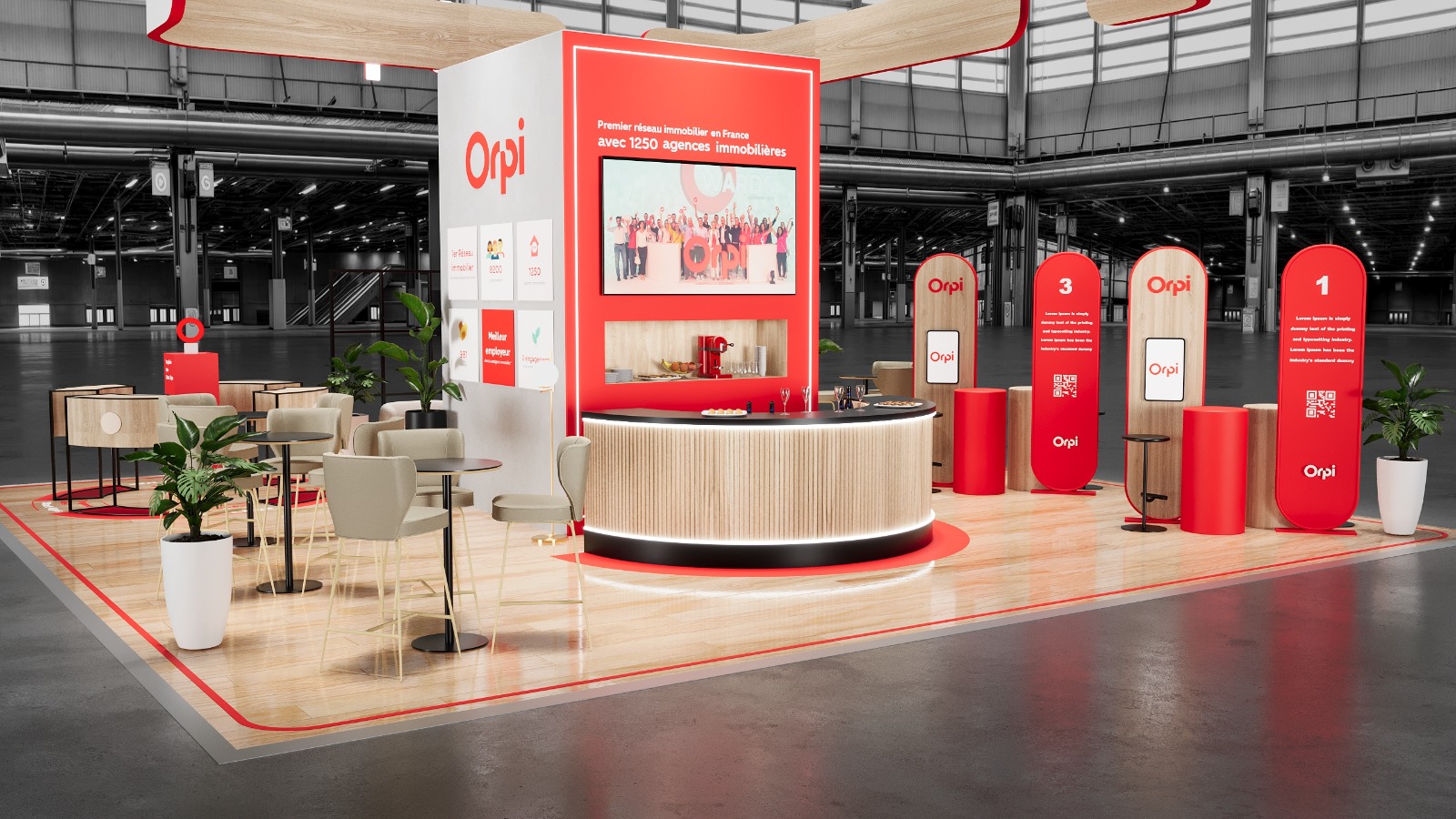
The 3D rendering is not just a presentation image. It's the moment when the intention becomes concrete.
It lets you virtually move around the space, observing perspectives, feeling volumes and anticipating circulation.
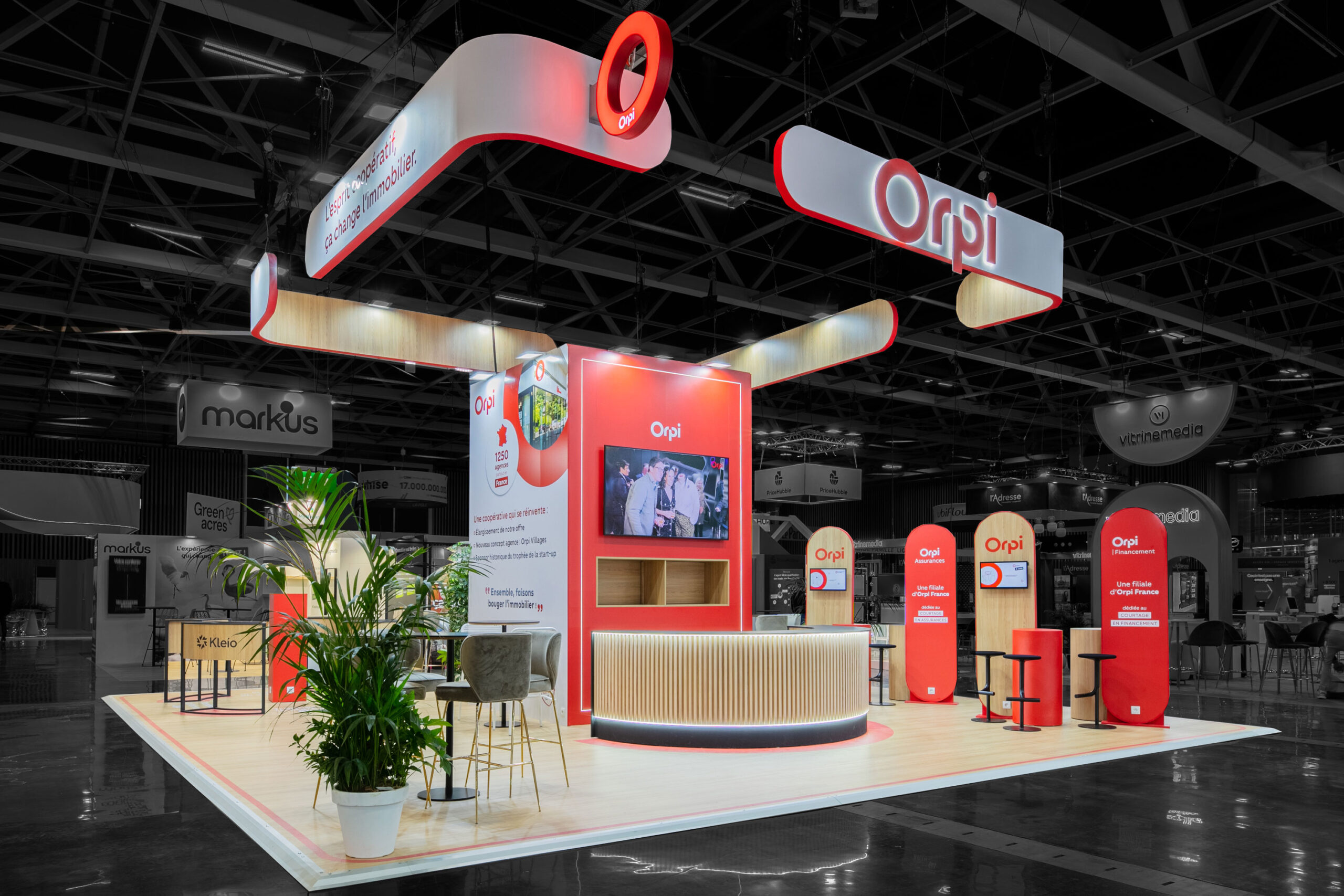
It's no longer a plan. It's not yet a stand. It's a faithful projection of what will actually exist at the show.
At WENES Stand, 3D modeling is carried out with a level of precision that often confuses visuals with reality. Comparing the 3D model with the final stand shows just how much attention is paid to every detail upstream.
This phase is strategic for several reasons:
-
It allows you to project a creation from brief to reality, even before you start manufacturing.
-
It offers the possibility of validating a concept in its entirety, and finding it exactly the same during assembly, with no unpleasant surprises.
-
It allows you to adjust the proportions, heights, openings and layout beforehand, to ensure overall balance and visual impact.
3D also enables :
-
anticipate remote perception in an often visually saturated hall,
-
check legibility messages from different angles,
-
optimize lighting before installation,
-
secure choices in line with technical constraints.
It's often at this point that the most pertinent decisions are made. A slightly moved wall can improve fluidity. A rebalanced volume can enhance visibility. An open space can encourage exchange.
3D rendering brings a form of serenity. It transforms intuition into certainty.
And above all, it commits to a promise: what is validated upstream must be faithful to the reality on the day.




Custom stand engineering and manufacturing
Behind every architectural line is a structural reality.
A custom-built stand is more than just aesthetically pleasing. It should last 2 - 3 or sometimes 10 days, They can be assembled, comply with strict standards and operate perfectly in a constrained environment.
Technical plans (electricity, joinery, etc.), fire standards, permissible floor loads, maximum authorized heights, organizer approvals, etc. These elements are not administrative formalities: they determine the feasibility of the project..
A suspended volume requires a precise study of hanging points to order the right quantities of slings. A large LED screen modifies loads. A floor or mezzanine requires specific structural validation.
This is where engineering comes into its own.
Experience in the field enables us to anticipate specific features of each exhibition center : restricted access, compressed installation schedules, electrical constraints, local regulations.
This technical expertise is part of the global approach promoted by the WENES Group, where design, production and coordination are not compartmentalized, but considered together from the outset of the project.
From validation to production
Once the concept has been validated, production begins.
A custom-built stand is made specifically for a given project. It is not assembled from standardized components: each piece has a specific purpose.
Manufacturing involves :
-
a millimetric precision in the cut-outs,
-
a perfect consistency between structure and trim,
-
a special attention to finishes visible... and invisible.
After all, on a showroom floor, perception is all about the detail. A misaligned joint, an uneven surface or poor lighting immediately affect perceived quality.
Conversely, when volumes are right, materials are mastered and transitions are fluid, space gains in credibility. Manufacturing is therefore much more than an operational stage: it is the realization of the initial promise.
Designing today, thinking tomorrow
A made-to-measure stand can be designed to evolve, be adapted or partially reused over several events.
This strategic approach combines high architectural standards with a long-term vision.
We analyze these arbitration logics in our article 👇
From field to performance: exacting standards down to the last detail
A made-to-measure stand is not limited to what is designed in the workshop. It takes on its full dimension in the field.
Coordinating transport, managing access to the hall, respecting often tight assembly schedules, synchronizing technical connections: everything has to fit together precisely.
Mounting is not just a simple installation. It's the moment when strategy becomes tangible.
At the opening, there should be no approximations or surprises. The stand must be faithful to the validated vision, operational immediately, ready to welcome, present and convince.
After the show: thinking beyond the event
Closing the show does not mark the end of the project.
Controlled dismantling, possible storage, analysis of experience: each custom-built stand can be designed with evolution in mind.
Because a trade show rarely stands alone. It's often part of a global presence strategy. This long-term vision is an integral part of our approach.
Each stand begins with a conversation.
Creating a customized stand doesn't mean producing an ephemeral décor.
It's about designing a strategic space, capable of translating an ambition, structuring a message and supporting commercial performance. From the initial intention to the final dismantling, every step counts. It's the continuity between vision, technical requirements and field expertise that guarantees the result.
A successful stand doesn't happen by chance. It's about the method - and the experience of those who implement it.
Planning your next trade show appearance?
Let's talk about your goals, your surface and your ambition:
a made-to-measure stand is always built well before assembly.