
Trends stands 2026 : design, materials, digital
21/01/2026
In 2026, the stand design continues to transform.
As visitors' expectations evolve, brands are stepping up their visual consistency, the CSR issues are becoming widespread and premium modular solutions are expanding.

The result?
Exhibition stands are no longer simply surfaces to be fitted out, but genuine brand experiences.
Whether you opt for a custom-built stand or a modular stand, here are the key 2026 trends you need to know about for your next trade shows.
1. Experience-first“ stands: the visitor at the heart of design
The “experience-first” trend is not a creative fad.
It is a direct response to an observation in the field: visitors have less time, less patience and a shorter attention span in ever denser halls.
In 2026, the most efficient stands will be designed by as pathways, and not as static showcases.
3 key points to understand this trend:
- Changing visitor expectations (fewer documents, more experience),
- Direct influence of experiential retail,
- Lobby saturation → need to attract attention in other ways.
Over the past few editions, we have observed that the best-performing stands :
-
- have a clear career path,
- tell a story,
- don't try to say it all.
👉 It's not a “fad”, it's a behavioral response.
The best-selling stands are those that tell a story history :
we understand who you are, what you propose, and why it matters.
2. Premium minimalism: clean lines, strong volumes
The return of premium minimalism can be explained by growing visual fatigue at trade shows.
Faced with overcrowded stands, the visitor's brain instinctively seeks out clarity.
In 2026, stand design is clearly inspired by :
- contemporary architecture,
- retail design,
- codes of discreet luxury.
We observe :
- clean lines,
- strong geometric volumes (arches, blocks, frames),
- a palette of sober colors (off-white, sand, terracotta, anthracite, deep blue),
- light wood and natural materials.
This premium minimalism allows :
- showcase your products and teams,
- make the brand immediately legible,
- to create an elegant, structured stand without overloading.
This trend applies equally to customized stands than high-end modular stands, It's all part of the package, as long as the design is well thought out from the outset.
3. Scenic lighting: an atmosphere crafted to the millimeter
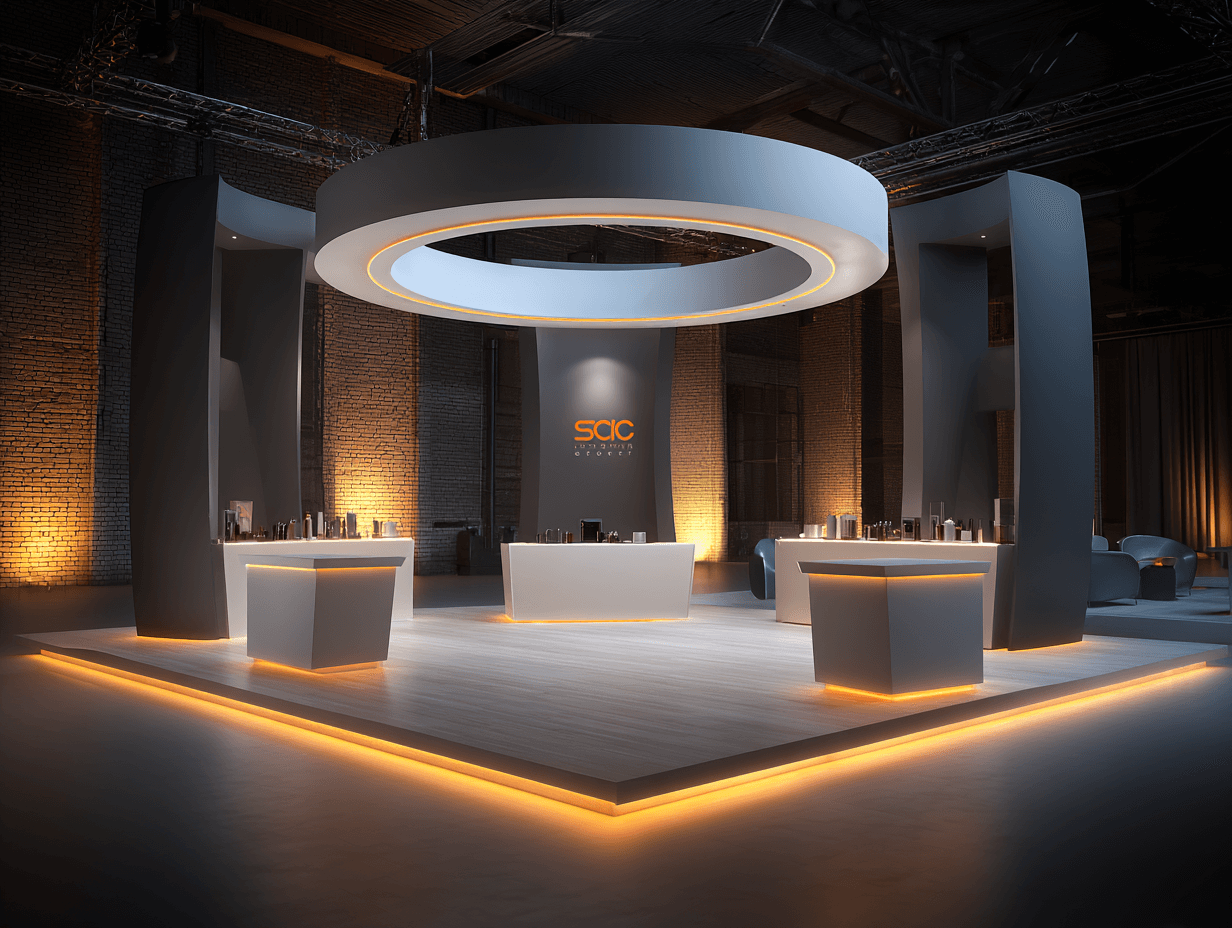
For a long time confined to a purely technical function, in 2026 lighting became an essential part of our daily lives. central element of stand design.
This evolution is made possible by :
- the democratization of integrated LED technologies,
- better cost control,
- increasing the skills of event scenographers.
We are seeing more and more :
- LED lines integrated into ceilings and walls,
- the luminous halos behind logos and messages,
- accent zones on products,
- different lighting moods for different areas (reception, demo, meeting).
Why is this trend key?
Because light lets you prioritize messages, guide the eye and structure the space without adding material.
A good lighting design transforms a simple stand into a striking one, while retaining its sobriety.



4. Sustainable materials and eco-design: design as proof of commitment
In 2026, sustainability is no longer a rhetoric: it's a reality. design criteria.
Regulatory pressure, corporate CSR commitments and the internal expectations of marketing departments are imposing a new reality.
This translates into :
- the use of certified wood (FSC, PEFC),
- recycled or recyclable materials,
- responsible printed textiles,
- less polluting paints and glues,
- design for reuse,
- scalable modular structures.
Why is this trend a must?
Because today, the stand becomes tangible proof of the brand's commitments.
Design must not only be beautiful, it must also be consistent with the company's stated values.
Complementarity between sustainable made-to-measure stand and reusable modular stand s’inscrit pleinement dans cette logique. Pour comprendre concrètement ce que recouvre cette démarche chez WENES Stand, découvrez notre approche RSE standiste : matériaux certifiés, fin de vie des stands, achats responsables.
5. Elegantly integrated digital: fewer screens, but better utilization
After several years of technological overkill, digital displays are undergoing a natural evolution.
Lobbies saturated with screens have shown their limits: a single screen no longer attracts.
In 2026, digital becomes more discreet but better integrated:
- screens integrated into the architecture (niches, frames, totems),
- short, readable, contextualized content,
- targeted demonstrations rather than permanent distribution,
- reduced visual pollution.
Why this shift?
Because the show is first and foremost a a place where people meet.
Digital technology must enrich exchanges, not replace them. It becomes a support for the experience, not an end in itself.
6. Verticality and multi-height to stand out in lobbies
Trade shows are still very busy environments.
To emerge, the 2026 stands are increasingly exploiting the verticality :
- tall, slender totems carrying the brand,
- graphic suspended structures,
- backlit vertical panels,
- level play on ceilings (recesses, false ceilings, frames).
Why does this approach work?
Because it allows :
- to be visible from afar,
- structure the space,
- reinforce architectural identity,
- without complicating ground organization.
Even on a modular stand, verticality can be seen as a key element in the design. reusable and differentiating.
7. Textures and sensory materials: adding depth to the stand
After some very digital years, the show is once again a place where the tangible account.
In 2026, the stand is more than just seen: it's felt.
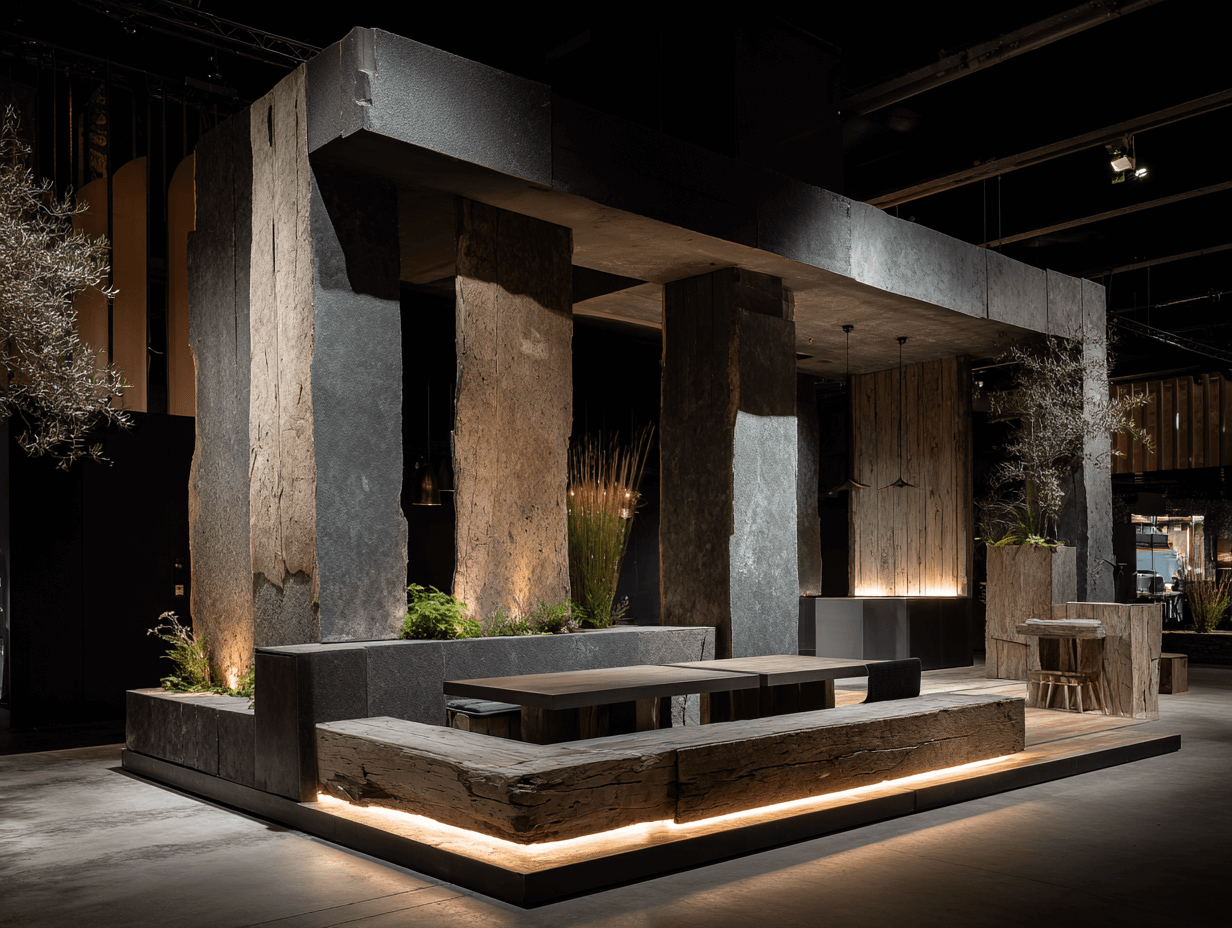
The return of :
- grooved or ribbed wood,
- stone or concrete-effect panels,
- textured and acoustic fabrics,
- matt surfaces,
- furniture in soft, welcoming shapes.
Why this trend?
Because materials create a emotional connection.
This work with materials creates a atmosphere We've got you covered: warmer, more serious, more technological... depending on your positioning.



8. The rise of the hybrid stand: custom + modular
Finally, a major trend in 2026: the hybrid stand, halfway between made-to-measure and modular.
The principle:
- a robust, reusable modular base,
- enriched with customized elements (scenography, counters, signature structures),
- designed from the outset to be reconfigured according to the show.
Why this approach?
Because it simultaneously responds to :
- the search for visual impact,
- la multiplication des événements,
- la durabilité,
- la cohérence budgétaire et organisationnelle.
Le stand hybride n’est pas un compromis : c’est une évolution mature du métier.
Vous hésitez entre les trois options ? Notre matrice d’aide au choix sur-mesure, modulaire ou hybride vous guide selon votre fréquence de participation et vos objectifs.
Conclusion : un design de stand 2026 plus intelligent, plus lisible, plus responsable
Les tendances design de stands 2026 convergent toutes vers une même logique :
- plus d’attention portée à l’expérience visiteur,
- un design minimaliste mais premium,
- une lumière scénographiée,
- des matériaux plus responsables,
- un digital mieux intégré,
- une exploitation intelligente de la verticalité,
- une complémentarité renforcée entre sur-mesure et modulaire.
En 2026, un stand efficace n’est pas celui qui en fait le plus, mais celui qui fait juste.
Et c’est précisément cette justesse — stratégique, esthétique et humaine — qui fera la différence sur les salons professionnels
Que vous soyez sur un salon stratégique unique ou sur une tournée de plusieurs événements, ces tendances peuvent être adaptées à votre réalité, à votre budget et à votre image.
Prêt à passer à l’action ? Commencez par préparer votre brief standiste — c’est l’étape qui conditionne tout le reste.