
3D rendering of a stand more than just an image
10/03/2026
There's a special moment in the life of every stand project.
It's the moment when exchanges, ideas and intentions put down on paper are suddenly transformed into something concrete. Something you can see, experience and feel.
This moment is the 3D rendering.

3D rendering is the volumetric and photorealistic modeling of a stand before it is manufactured. It enables the customer to visualize the space in its actual proportions, validate architectural choices and anticipate the visitor experience, even before the first piece is produced.
It's a working tool. Strategic, precise and often decisive.
From intention to projection: when space takes shape
A brief, however precise, remains an abstraction. Square meters. Objectives. Visual references. All this exists in people's heads, in exchanges, in shared documents.
But a stand is a space. A volume that you inhabit, that you walk through, that you perceive from a distance even before you enter it.
3D rendering bridges the gap between what we imagine and what we actually see.
It provides answers to questions that the technical plans do not ask:
How does it feel to enter this space? Is the main message legible from the main aisle? Is the meeting area accessible without interrupting the flow of visitors? Are the proportions right, or is there something unbalanced?
These seem like simple questions. Yet, without 3D, they remain unanswered until editing.
What 3D makes possible - and what it prevents
Validate a concept before going into production
A made-to-measure stand involves specific manufacturing, deadlines and commitments. Modifying an element once production has begun costs time, energy and sometimes peace of mind.
3D rendering is the window during which everything can still be freely adjusted.
A repositioned counter. A wider opening. A slimmer volume for greater fluidity. Reworked lighting to enhance a key product.
These decisions, taken at this stage, only cost a file correction. Taken later, they cost much more.
Projecting yourself in your stand - really
Reading a plan requires an effort of interpretation. So does understanding a technical section.
3D, on the other hand, speaks immediately.
It allows each person involved - whether marketing director, sales manager or executive - to visualize the space effortlessly. To feel what the visitor will feel. To take a stand.
It's a tool for dialogue as well as validation.
Anticipating what you can't yet see
3D can also be used to test hypotheses that are invisible at this stage of the project.
How will the stand be perceived from the main aisle, with the actual flow of visitors? Does the lighting create the desired contrasts or overpower the chosen materials? Is signage legible from a distance of 10 meters?
These checks prevent setbacks that would otherwise only be discovered on the day of installation. That's too late.
When 3D and reality merge
At WENES Stand, 3D rendering is not an exercise in style. It's a promise.
The promise that what is validated upstream will be faithfully reproduced at the show.
Proportions. Materials. Lights. Volumes.
When we compare our models with the stands we deliver, the resemblance is no coincidence. It's the result of rigorous design and continuity between the creative and manufacturing teams.
A successful stand holds no surprises on the day of assembly. It confirms what was imagined, and often exceeds it.
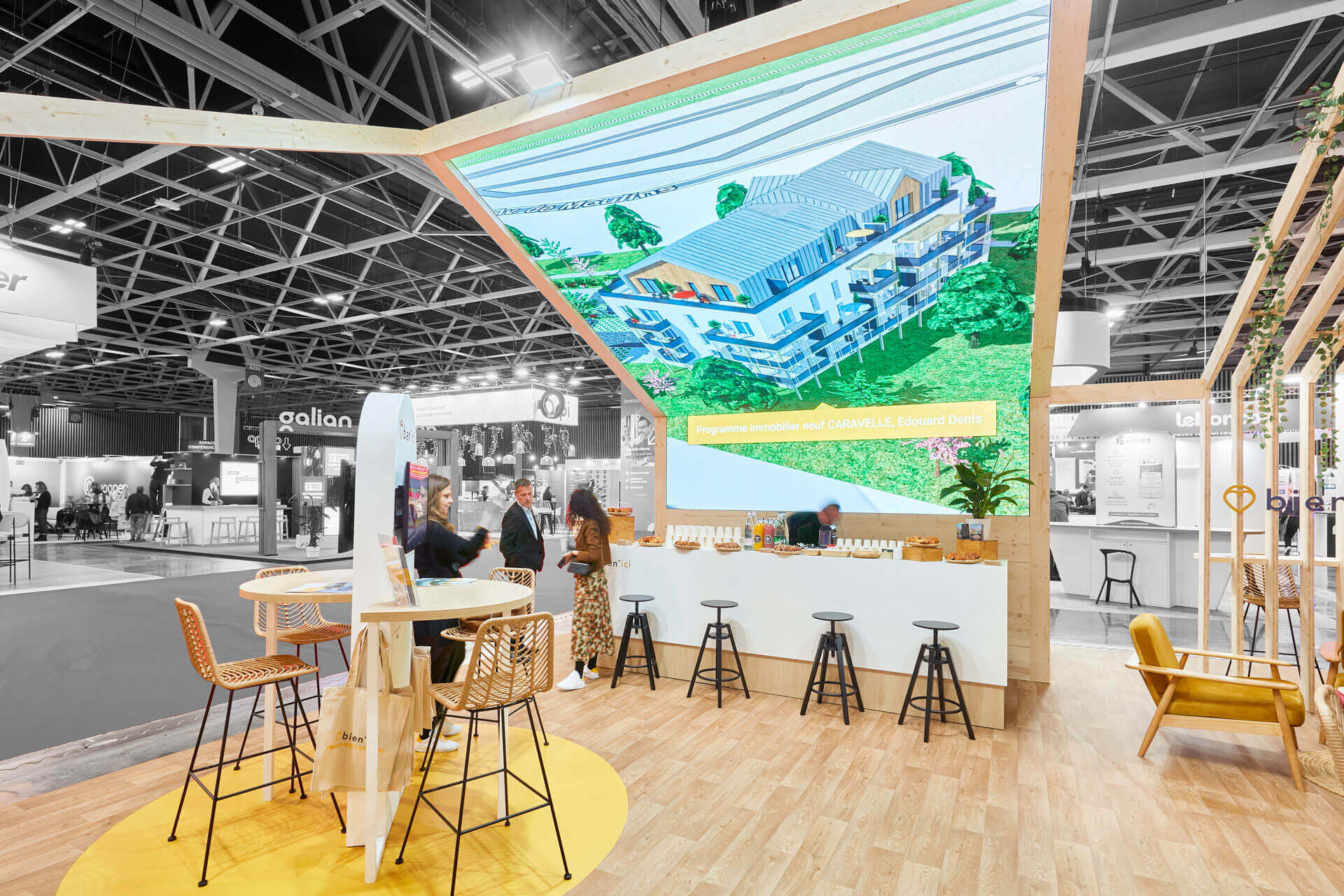


Bien'ici at RENT - when 3D must deliver on the promise of innovation
Winning a tender is one thing. Fulfilling it without disappointing is something else entirely.
When Bien'ici entrusted WENES Stand with the design of its stand at the RENT trade show, its ambitions were clearly defined: to meet a need for innovation, to showcase the 3D card through an immersive animation, and to create a warm, welcoming space in keeping with the brand's identity.
With an additional, structuring constraint: to design a stand that could be reused at two separate shows, with completely different surface areas.
The technical challenge was equal to the ambition.
At the heart of the concept: a giant LED screen, integrated into the structure of the house roof, to project a customized video of the 3D map - the platform's signature tool. A unique device, designed to create an unprecedented immersive experience for this type of event.
This is precisely where 3D rendering played a central role.
Integrating a screen of this size directly into the structure of a roof, guaranteeing the solidity of the whole, the legibility of the projection from the aisles, and the reusability of the device in two different configurations - this type of challenge cannot be improvised on the day of installation. Every constraint must be anticipated, modeled and validated.
3D allowed us to verify that the concept would fit within its actual dimensions. That the immersive animation would work in both cases. That Bien'ici's visual identity would be fully legible, whatever the surface.
The result exceeded expectations.
Spectacular from the outset, the stand caught the eye even before the show opened. Two days of assembly turned into an unintentional demonstration - and a stand that lived up to all its promises on the big day.
To remember: When a concept combines creative ambition, complex technical integration and reusability constraints, 3D is not a comfort stage. It's what makes the project feasible - and deliverable, with no surprises.
3D as a collective decision-making tool
In many organizations, the decision to validate a stand involves several people.
A marketing department. General management. A communications department. Sales teams who will be present at the show and have a say in the space.
3D speaks on all these levels simultaneously.
It eliminates the need for time-consuming translation work between a technical vision and a layman's understanding. It aligns stakeholders around the same representation. It speeds up validations - and reduces last-minute misunderstandings.
It's a tool for organizational fluidity as much as for creation.
What 3D does not replace
3D modeling is a powerful tool. But it's no substitute for conversation.
It comes after listening, after the brief, after the creative design phase. It translates into images a reflection that has already taken place.
This is why the quality of a 3D rendering is inextricably linked to the quality of the brief that preceded it. A well-modeled stand with a blurred base will always be a poorly oriented stand.
3D reveals the accuracy of a project. It doesn't create it.
👉 To understand how this phase fits into the whole process, read our article : How do you go about creating a customized stand? From the idea to the big day
In a nutshell: the 5 strategic roles of 3D rendering
To answer the question we're often asked: what's the real use of 3D in a stand project?
- View - project into real space before manufacturing
- Confirm - confirm architectural, aesthetic and functional choices
- Adjust - correct freely, at no extra cost
- Align - federate all stakeholders around a single vision
- Anticipate - identify friction points before they become problems in the field
FAQ - 3D rendering and stand design
When are 3D renderings produced?
3D rendering comes after the briefing and creative design phase, before manufacturing begins. This is the central validation stage of the project: it's here that architectural and aesthetic choices are confirmed, adjusted if necessary, and then committed to production.
How many 3D rendering versions are available?
Several iterations are carried out until complete validation. The number of iterations depends on the complexity of the project and the adjustments required. The objective is constant: to achieve a rendering that both parties fully validate. What is approved in 3D is what will be delivered.
Does the 3D rendering really match the final stand?
Yes, and that's precisely its value. Fidelity between modeling and final production is the result of direct continuity between the design and manufacturing teams. What is validated upstream is identical on the show floor.
Can I modify my stand once the 3D rendering has been validated?
Minor adjustments are still possible, depending on the stage of production. But the earlier and clearer the validation, the smoother and more precise the project becomes. That's why this stage deserves the full attention of all stakeholders.